When a company goes public, most people watch the stock chart.
But in certain cities, the more important chart may be much closer to the ground: home prices, rents, traffic, school demand, local services, and the quiet cost of building a life near the next great economic engine.
That is why SpaceX's historic public offering matters beyond investors. For Brownsville, Starbase, and the broader Rio Grande Valley, the question is not simply whether SpaceX becomes one of the most valuable companies in the world. The more human question is this:
What happens to a place when the world suddenly starts pricing in its future?
For people thinking about moving to Brownsville, relocating for aerospace work, buying near Starbase, or comparing South Texas with Austin, Houston, Florida, California, or another fast-changing market, this is the moment to look carefully. Not with fear. Not with hype. But with a clear understanding of how boomtowns work.
A major IPO can create opportunity. It can also change the math.
The SpaceX effect is now bigger than a launch site
For years, SpaceX's presence near Boca Chica and Brownsville was treated as a bold experiment on the edge of Texas: part rocket program, part industrial campus, part symbol of a new space economy.
Now it is something larger.
With SpaceX entering the public markets, the company's story becomes easier for investors, employees, suppliers, contractors, real estate developers, and job seekers to understand. Public companies live under a brighter spotlight. Their growth plans become part of broader market conversation. Their headquarters, campuses, launch sites, and surrounding towns often become part of the investment imagination.
That does not mean Brownsville becomes Austin overnight. It almost certainly does not.
But it does mean more people may begin asking the same practical questions:
- Should I move there before costs rise further?
- Is Brownsville still affordable?
- Will aerospace jobs bring long-term stability?
- Will rents and home prices rise faster than wages?
- Is this a good place for families, remote workers, engineers, contractors, or small business owners?
Those questions are exactly where relocation decisions become complicated. A city can be affordable on paper and still become expensive in real life if housing supply, insurance, transportation, childcare, healthcare, and moving costs are not evaluated together.
Brownsville is not Silicon Valley — and that is the point
One reason Brownsville has drawn attention is that it is not San Francisco, Los Angeles, Seattle, or Austin.
It is historically more affordable. It is borderland, coastal, industrial, entrepreneurial, and culturally distinct. It sits in a region where family networks, local identity, education, trade, logistics, and cross-border life all matter. It is not merely a cheaper place to work near rockets. It is a real community with its own rhythm.
That is important because many people make the mistake of comparing boomtowns only by salary and housing price.
A move to Brownsville may look attractive if you are coming from California, New York, Washington, or another high-cost metro. A home price that feels high to a longtime local resident may still look affordable to a tech worker or aerospace engineer relocating from a coastal market. That difference in purchasing power can quietly change a local housing market.
This is how affordability gaps become pressure points.
When outside buyers arrive with higher incomes, stronger savings, or equity from expensive housing markets, they can bid differently. Developers notice. Landlords notice. Sellers notice. Service providers notice. Over time, the local cost structure begins to shift.
The city may still be affordable compared with national tech hubs. But it may become less affordable for the people who already live there.
That is the delicate tension behind many boomtown stories.
Opportunity is not the same as affordability.
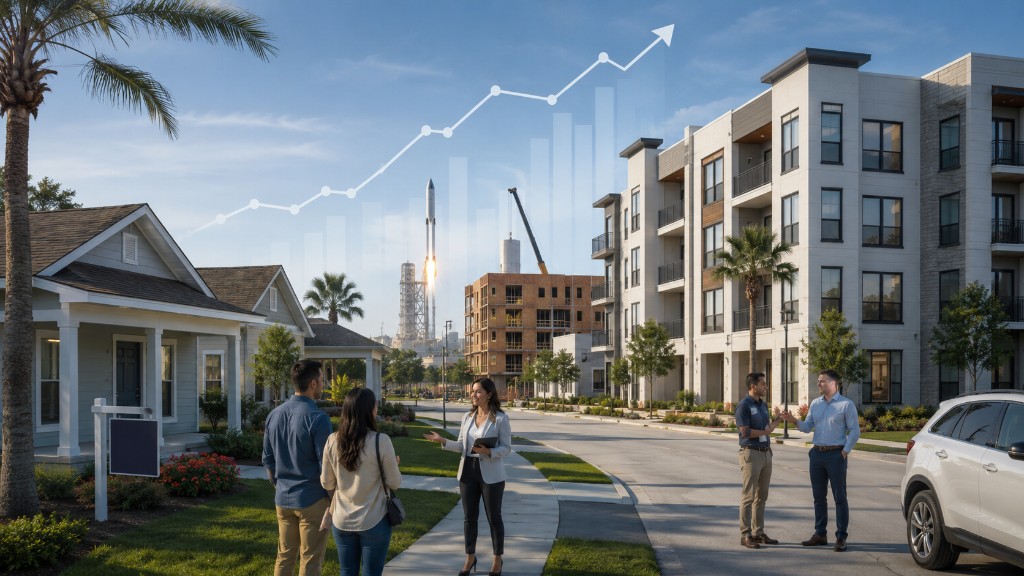
Outside attention can change a local market long before wages catch up.
The first cost to watch is housing — but not only home prices
Most people begin with the obvious question: will home prices rise?
That matters, but it is only the first layer.
For a relocating household, the more useful question is: what is the total housing burden after the move?
That includes:
- Mortgage or rent
- Property taxes
- Insurance
- Utilities
- Repairs and maintenance
- Commuting distance
- Temporary housing
- Storage
- Furniture replacement
- Closing costs or deposits
- School district tradeoffs
- Time spent searching
- The risk of moving too early or too late
In a fast-changing market, the listed home price can be misleading. A buyer may find a house that looks affordable, then discover that insurance, repairs, commute patterns, and limited inventory change the real monthly cost. A renter may find a reasonable lease, then face higher renewal pressure one year later if demand accelerates.
The SpaceX IPO does not automatically make Brownsville expensive. But it may increase the number of people watching the market, and attention itself can become a market force.
The second cost is timing
Boomtown relocation often punishes people at both extremes.
Move too early, and the opportunity may not fully arrive. You may deal with limited services, uncertain job growth, infrastructure gaps, or a thinner professional network than expected.
Move too late, and the best housing values may already be gone. Rents may have adjusted. Contractors may be busy. Schools may be more crowded. Local roads may feel different. A move that once felt simple becomes more expensive and more competitive.
This is why people should not ask only, "Is Brownsville cheap?"
They should ask:
- What is likely to change in the next two to five years?
- Is housing supply keeping up with demand?
- Will my income grow with the local economy?
- Can I afford the move if rents rise after the first year?
- What happens if the job opportunity changes?
- Can my family actually enjoy life there, not just afford it?
A city is not a spreadsheet. It is a lived environment. The numbers matter because they shape the quality of daily life.
A boomtown is not defined by headlines. It is defined by what it does to your monthly budget.
The third cost is the hidden cost of local transformation
When a major employer grows, a city often changes in visible and invisible ways.
Visible changes are easy to see: new apartments, more construction, more restaurants, more traffic, more national attention, more real estate listings using phrases like "near SpaceX" or "minutes from Starbase."
Invisible changes matter just as much.
Local workers may face higher rents. Small businesses may see both opportunity and higher costs. Families may find more career options but also more competition for housing. Schools may see new demand. Public services may need to adapt. The local identity may feel pulled between pride and pressure.
For newcomers, this creates a responsibility: do not treat a city as a trade.
If you move to a place like Brownsville, you are not just buying into a trend. You are entering a community.
That mindset leads to better decisions. It encourages people to ask not only "Can I afford this?" but also "Can I belong here?" and "Will this move improve my life without ignoring the people already living there?"
Who should consider Brownsville now?
Brownsville may make sense for several types of movers.
Aerospace workers and contractors may see career advantages from being closer to Starbase and related suppliers. Entrepreneurs may see opportunities in services, housing, logistics, hospitality, education, and local business development. Remote workers may see a lower-cost base with proximity to the Gulf Coast, Mexico, and a fast-growing industrial story. Families may see a chance to build a life in a region that feels more grounded than a major tech metro.
But each group should evaluate Brownsville differently.
A single engineer can tolerate more uncertainty than a family with school-age children. A remote worker can move for lifestyle, but may still need reliable internet, healthcare access, airport convenience, and community fit. A real estate investor may focus on appreciation, but a household needs stability. A contractor may follow the work, but should also plan for project cycles.
The right move depends on the life being built.
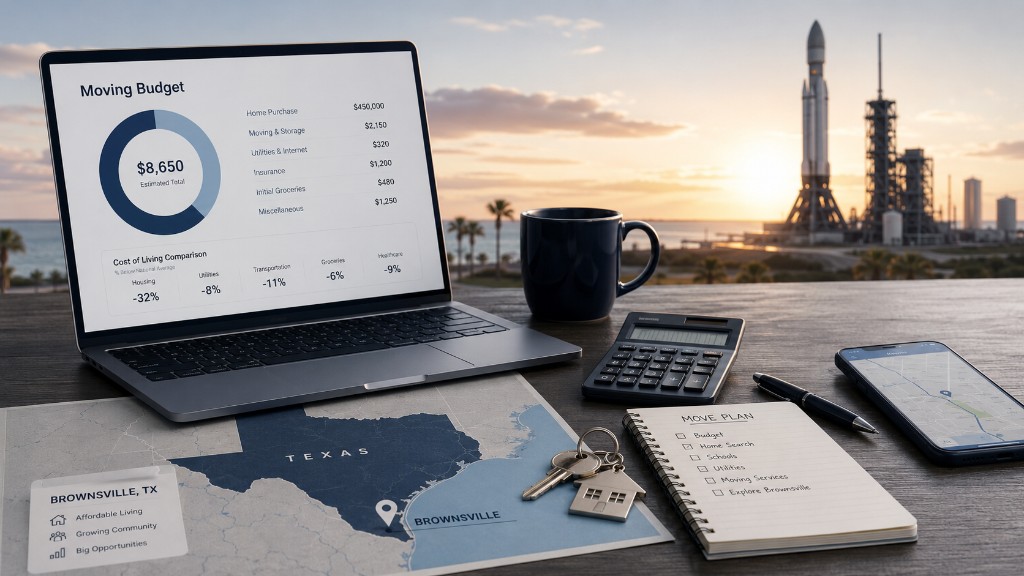
The listed price is rarely the full picture. Total housing burden includes taxes, insurance, setup, and timing.
What movers should compare before relocating
Before moving to Brownsville or any fast-changing boomtown, compare at least six categories.
1. Housing reality
Look at both purchase and rental options. Compare current listings with recent market data. Do not rely on one attractive listing. Ask whether the homes you would actually want are still affordable after taxes, insurance, repairs, and financing.
2. Income durability
A move tied to one employer, one industry, or one project should be evaluated carefully. SpaceX may be the center of the story, but your household needs a plan if your role changes, your contract ends, or your industry shifts.
3. Transportation and access
Brownsville is not only a housing market. It is a location. Consider commute routes, airport access, cross-border travel, fuel costs, car insurance, and whether your daily life depends on long drives.
4. Services and lifestyle
Healthcare, childcare, schools, restaurants, coworking spaces, gyms, storage, moving services, and professional networks all affect the real cost of living. A place can be affordable and still inconvenient if the services you need are limited or far away.
5. Insurance and climate
Coastal and Gulf-adjacent regions require extra attention. Flood risk, windstorm exposure, property insurance, and long-term resilience should be part of the relocation calculation.
6. Exit flexibility
A good relocation plan includes an exit plan. If you buy, can you resell? If you rent, can you leave after one year? If you move your family, how hard would it be to move again? Flexibility has financial value.

The best relocation decisions weigh opportunity, community, and total monthly cost together.
The real lesson: every boomtown has two prices
One price is visible.
It is the home price, the rent, the moving truck, the mortgage payment, the salary offer.
The other price is harder to see.
It is the cost of uncertainty, competition, timing, adaptation, and emotional energy. It is the cost of arriving in a place while that place is becoming something else.
Brownsville's future may be bright. SpaceX may bring jobs, investment, and global attention. Starbase may become one of the most recognizable industrial communities in America. South Texas may gain a new role in the space economy.
But for movers, optimism is not enough.
The smart move is not to chase a headline. It is to understand the full cost of the life behind the headline.
The smartest move is not chasing attention. It is comparing total life cost before you relocate.
Before you move to the next boomtown
SpaceX's IPO may be a Wall Street event, but Brownsville's story is a Main Street question.
Who can afford to live near the future?
Who benefits from the growth?
Who gets priced out?
And for the person or family considering a move, what does the decision actually cost — not just this month, but over the next several years?
That is the kind of question every mover should ask before relocating to a fast-changing city.
Before moving to Brownsville, Starbase, Austin, Miami, Lisbon, Dubai, or any other city shaped by ambition and attention, compare the full picture: housing, taxes, transportation, insurance, services, lifestyle, risk, timing, and personal fit.
A great move is not just about going where opportunity is.
It is about knowing whether that opportunity can become a better life.
Source note: This analysis references SpaceX's official IPO pricing announcement, Reuters reporting on the IPO debut, U.S. Census Bureau QuickFacts for Brownsville, and current housing-market data from Zillow and Redfin.