
Some people live in a city for years and still never feel fully settled.
They have a job.
They have a place to live.
They know the grocery stores, the restaurants, the streets, the shortcuts, the cafés that are worth returning to.
They know which roads get crowded, which neighborhoods feel safe, and which parts of town they would rather avoid at night.
From the outside, their life may look stable.
But inside, there is a quiet feeling that never quite goes away:
"Somehow, this doesn't feel like my place."
It is not that they never tried to adapt. They tried making friends. They tried changing apartments. They tried changing jobs, routines, habits, expectations.
They may even look like they are doing fine. And yet, something in them still feels temporary. Not lost exactly. Not broken. Just misplaced.
Not Every City Is Meant for Every Person
When we think about choosing a city, we usually start with practical questions. Are there enough job opportunities? Is the cost of living manageable? Is the weather good?
Is transportation easy? Can I afford the rent? What about taxes, healthcare, education, safety, and quality of life?
These questions matter. But there is another question that is more difficult to measure, and often more important than we realize:
Does the personality of this city match the rhythm of who you are?
Some people need the speed, density, ambition, and unpredictability of a major city. They may complain about the pressure, but when they leave that energy for too long, life starts to feel strangely unplugged.
Some people need mountains, ocean, trees, sunlight, and a wider sky. They are not lazy. They are not antisocial. They may simply be living for too long in a place that gives their nervous system no room to breathe.
Some people need community, familiarity, neighborhood rituals, and the warmth of everyday human connection. A city that is too anonymous, too mobile, or too individualistic can make them feel deeply alone.
Others need distance. They need freedom, privacy, movement, and the chance to become someone new in a place where no one already knows their story. For them, a city that is too familiar, too small, or too settled can feel like a room with no windows.
So the real question is not always: "Is this a good city?" Sometimes the better question is: "Is this a good city for me?"
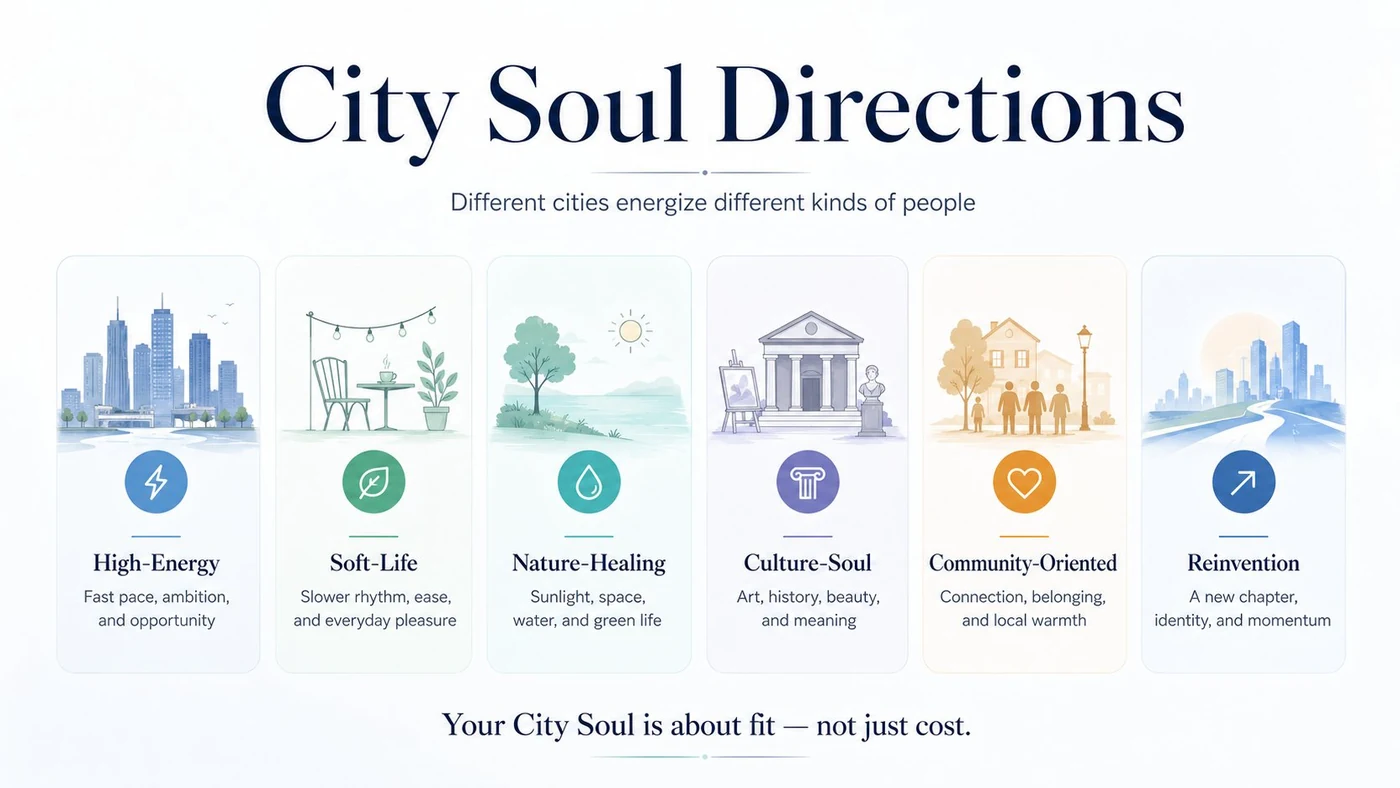
City Fit is not only about cost. It is about how a place matches your rhythm, energy, lifestyle, opportunities, comfort, and culture.
City Misalignment Is a Real Kind of Exhaustion
You may know someone like this. They have lived for years in New York, London, or another fast-moving global city.
Their résumé is stronger than ever. Their income has improved. Their skills have sharpened. Their network looks impressive.
But their eyes look more tired. Their weekends feel heavier. Their phone is full of contacts, but there are fewer people they actually want to sit with for a long, unhurried meal.
They are not failing. They are simply paying a very high emotional price to maintain a version of life that does not nourish them.
You may also know the opposite kind of person. Someone lives in a quiet, affordable, stable town. The pace is manageable. The home is comfortable. Life is safe.
But inside, they feel as if someone has pressed pause on their future. They do not hate stability. They just have parts of themselves that need more movement, more possibility, more world.
And then there are people who move closer to the ocean, the mountains, or a sunnier place — and suddenly they seem to come back to life.
They sleep better. They walk more. They breathe more deeply. They become softer, calmer, more alive. They did not become a different person. They simply entered an environment that fit them better.
Wanting to Leave Is Not Always Escaping
When people start thinking about moving, they often question themselves. Am I unstable? Am I running away? Am I being unrealistic? Will I feel this way everywhere?
These are honest questions. A new city will not magically solve old relationships, old fears, or old habits. But not every desire to leave is a form of escape.
Sometimes the desire to leave is a very honest signal. It may mean:
The pace here no longer fits me. The opportunities here no longer excite me. The culture here is quietly draining me. I need a different environment in order to see myself clearly again.
People are not machines. We do not live by willpower alone. We are shaped by air, streets, noise, light, commuting, weather, people, culture, architecture, and the emotional temperature of the places we inhabit.
A city is not just the background of your life. It is part of the system that shapes your life every single day.
Someone Else's Paradise Can Be Your Place of Exhaustion
Some cities are widely described as dream destinations. They have opportunity, beauty, status, culture, energy, and global reputation. But even a dream city is not a dream for everyone.
One person finds ambition and direction in a major city. Another loses sleep and a sense of self there. One person finds peace and intimacy in a smaller town. Another feels trapped and invisible. One person heals near the sea. Another feels restless in a place that moves too slowly.
This is why the same city can feel like completely different worlds to different people. Cities are not simply good or bad. They are mirrors. They amplify what we need, what we avoid, what we long for, and what we have been ignoring.
Maybe It's Not You. Maybe It's the Fit.
In psychology, there is a useful idea called person-environment fit — the relationship between who you are and the environment you live in. When your values, personality, pace, and needs are constantly out of sync with your surroundings, the result is not always dramatic collapse. Sometimes it feels much quieter than that.
A low-grade anxiety. A daily heaviness. A sense of being slightly off. A feeling that life is technically fine, but not truly alive.
Many people mistake this for weakness. They tell themselves they should be tougher, more grateful, more disciplined, more adaptable. But sometimes the message is simpler:
This is not your place. And that is not a personal failure.
Cities are not neutral containers. They have personalities. They have atmospheres. They favor certain rhythms of life. New York often rewards people who become more alive under pressure. Kyoto may speak to those who can find beauty in stillness. Lisbon may attract people who are ready to make peace with time. Chengdu may feel natural to those who know that the present moment is not something to postpone.
You and a city are in a relationship. Some relationships feel natural. Some require constant negotiation. And some, no matter how much effort you give them, remain a compromise.
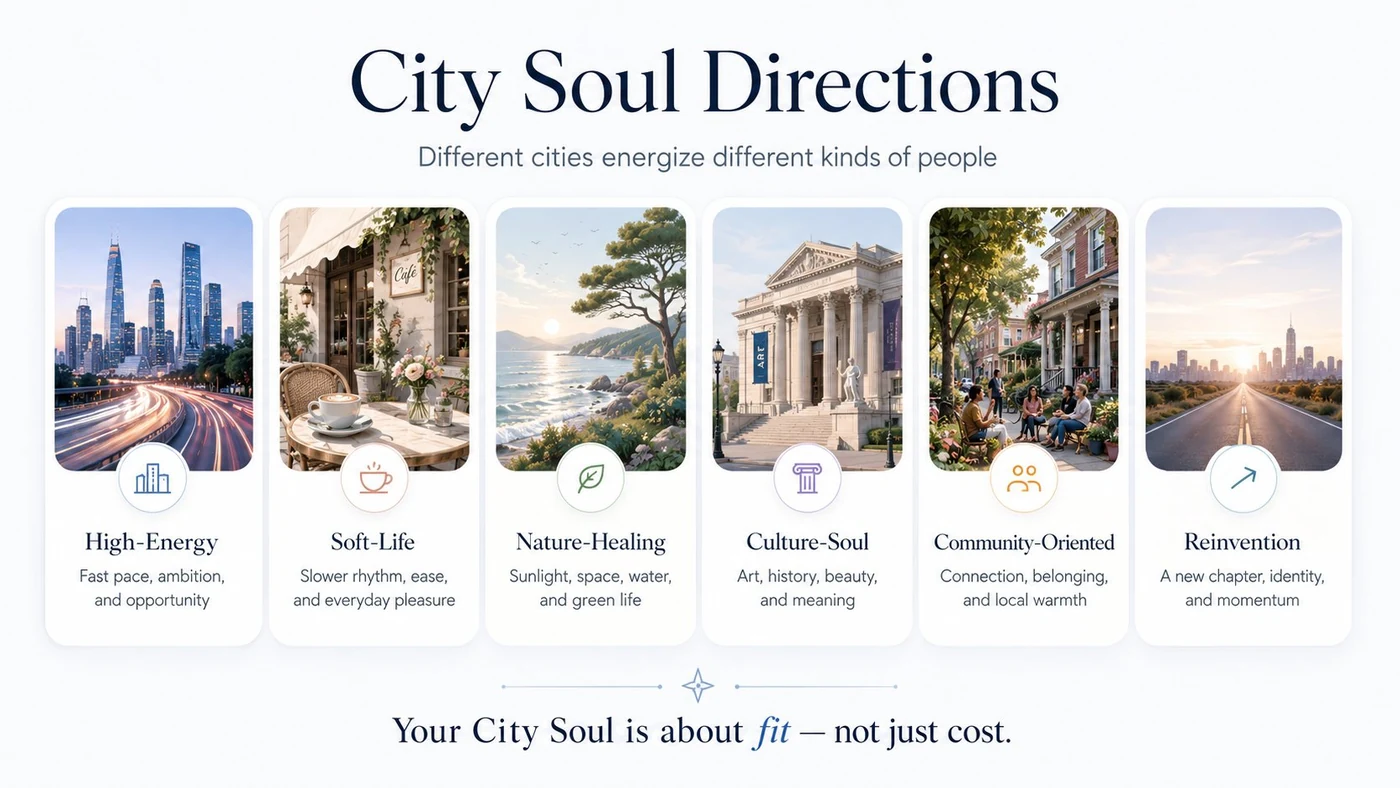
Different people come alive in different environments. The key is not finding the best city — but finding the city that fits you.
You Have a City Soul
Deep down, everyone has a hidden preference for a certain kind of city. You may be drawn to speed, opportunity, and upward momentum. Or to freedom, distance, and a lighter way of living. Or to nature, sunlight, and the feeling of your body finally relaxing. Or to culture, art, beauty, history, and streets that make ordinary life feel more meaningful.
These preferences are not random. They are shaped by your personality, your history, your stress patterns, your life stage, your sense of beauty, your need for freedom, and the kind of life you are quietly trying to build.
We call this inner sense of city alignment your City Soul.
Your City Soul is not a label meant to trap you in a category. It is a starting point. It helps you understand why some cities energize you. Why some cities drain you. Why you keep feeling drawn to certain kinds of places. Why someone else's ideal city may never feel like home to you.
Finding the Right City Is Not About Running Away
The most important question is not: "What is the best city?" The better question may be: "Which city helps me become more myself?"
Some places make you braver. Some make you softer. Some make you clearer. Some help you believe in life again. Some simply allow you to stop fighting your environment every single day.
Of course, no city is perfect. Every place has trade-offs. Every move requires practical thinking: money, immigration, work, family, healthcare, taxes, safety, friendships, and long-term stability. Our AI Planner can help you think through the real costs and logistics of any move.
But before all the calculations, there may be a more fundamental question worth asking:
What kind of city does my soul actually fit?
Not the city other people admire. Not the city at the top of a ranking. Not the city that looks beautiful in someone else's photos. But the place where you can slowly unfold. Where your energy returns. Where your life feels less like resistance and more like participation.
Find Your City Soul
You are not just choosing a city. You are choosing the environment that shapes the next version of your life.
Get Your Personalized Moving Cost Report
Full cost breakdown, visa guide, neighborhood analysis, and 90-day action plan — usually delivered to your email within a few minutes after payment.