When people choose a city, they usually start with practical questions.
Is the rent affordable? Are there enough job opportunities? Is the weather good? Is transportation easy? Are taxes reasonable? What about schools, healthcare, safety, and community?
These questions matter.
But if you have ever lived in a city that looked good on paper and still felt wrong in your body, you already know something important:
A city does not fit you just because it ranks well on a list.
Some cities look impressive, but slowly drain you. Some cities are imperfect, but help you recover. Some cities help other people come alive, while making you feel like you are constantly fighting yourself. Some places may seem ordinary to others, but for you, they become the first place where you sleep better, walk more, and feel like life is possible again.
So the real question is not: "Is this city good?"
Does this city actually fit you?
City Fit Is Not Just About Lower Cost
Many people begin thinking about relocation because of money. That makes sense. Rent, housing prices, taxes, insurance, transportation, healthcare, and daily expenses all affect how safe and stable life feels.
But lower cost does not automatically mean better fit.
Some places are affordable, but the opportunities are limited. Some places offer larger homes, but very little social energy. Some places are quiet and stable, but make you feel as if your life has been paused. Some places have low taxes, good weather, and cheaper housing, but lack the people, culture, career possibilities, or emotional rhythm you need.
The opposite can also be true. Some cities are expensive, yet make certain people feel more alive, more focused, and more ambitious. They are not unaware of the cost. They simply receive enough opportunity, information, connection, and energy from the city to justify the price.
Cost is only the first layer. Real city fit is a much deeper system.
You are not only asking: "Can I afford to live here?" You are also asking: "Can I become a better version of myself here?"
The Right City Makes Daily Life Feel a Little Lighter
A city that truly fits you will not make every day perfect. But it will reduce friction.
You do not feel exhausted before you even leave home. Your commute does not feel like a daily punishment. You want to walk. You want to explore. You want to meet people. You want to rebuild routines. You want to take your body, time, and future seriously again.
Many people think their poor life state comes from lack of discipline. Sometimes, that is true. But often, they are simply living in an environment that asks them to fight every day.
The climate does not fit. The pace does not fit. The space does not fit. The people do not fit. The cost structure does not fit. The speed of the city and the rhythm of the person are out of sync for too long.
This kind of mismatch does not destroy you in one dramatic moment. It works slowly. You lose a little energy each day. A little interest each week. A little hope each month. After a few years, you may begin to believe that you have become numb, anxious, lazy, or uninspired.
But maybe you have not become worse. Maybe the city simply never really held you.

The same person can feel compressed in one city and expanded in another.
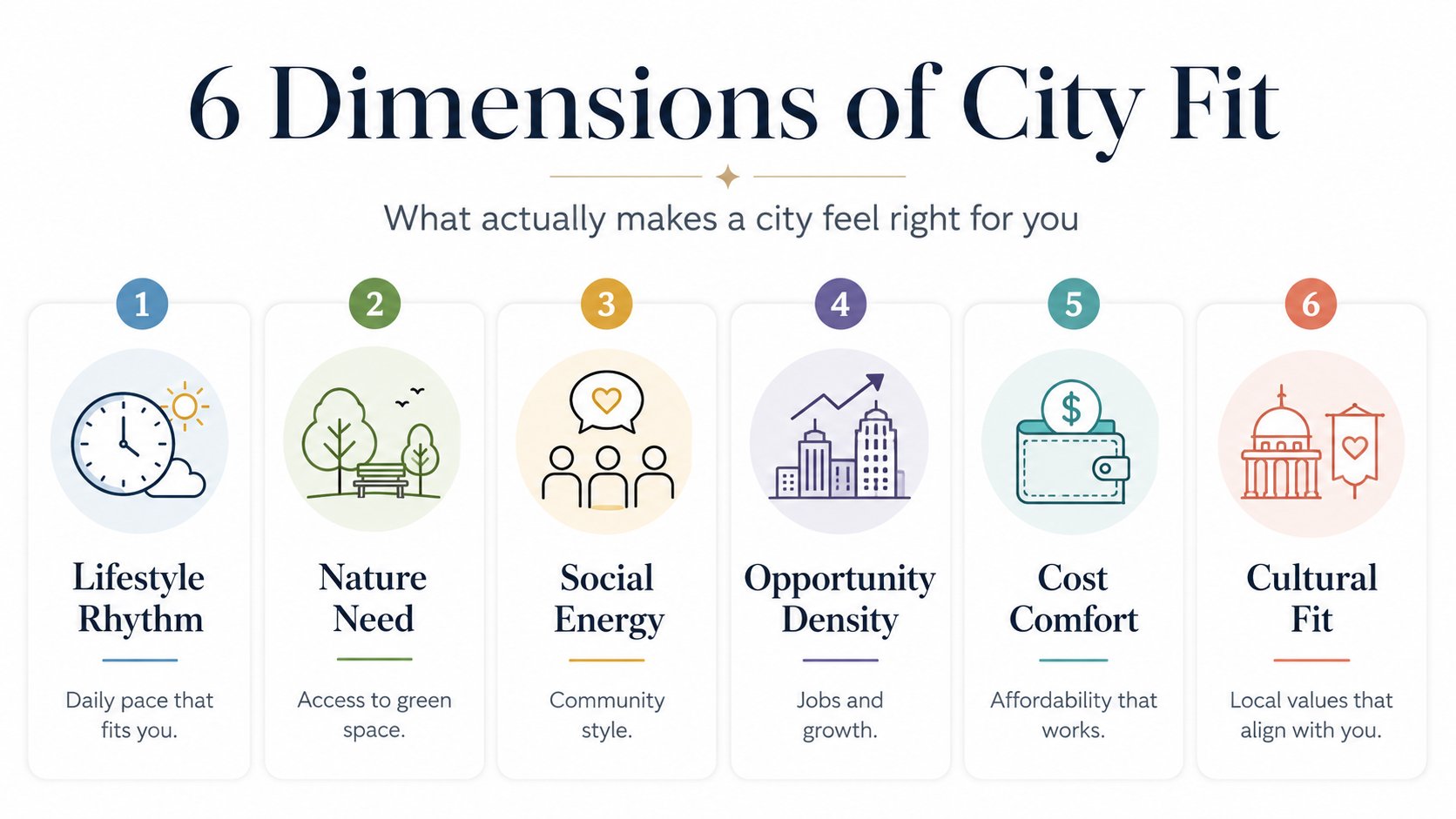
Six Dimensions of City Fit
City fit can sound emotional and abstract. But it can be understood through several practical dimensions.

City fit is not one thing. It is the relationship between your rhythm, environment, social needs, opportunities, cost structure, and cultural values.
1. Lifestyle Rhythm
Some people need speed. They like density, information, opportunity, change, and momentum. They may complain about large cities, but they are also charged by them. Put that kind of person in a place that is too slow or too predictable, and life may begin to feel flat.
Other people need a slower rhythm. More space. More routine. More quiet. More control over their day. Put them in a city that is too crowded and too competitive, and they may slowly lose emotional and physical stability.
Does this city's pace energize me, or does it pressure me?
2. Nature Need
Some people need nature more than they realize. They need sunlight, water, trees, parks, mountains, beaches, or open sky. This is not a luxury preference. For many people, the body responds directly to the environment.
A person who spends years without enough natural space may become anxious, dull, or emotionally compressed. But when that same person moves somewhere greener, brighter, or closer to water, their entire state can begin to change.
How much nature do I need in order to feel healthy and alive?
3. Social Energy
Some cities are highly anonymous. You can be free there. You can start over. For some people, this is liberation. For others, anonymity becomes loneliness.
They need community. Familiar faces. Local cafés. A sense of being known. The feeling that they are not just living somewhere, but belonging somewhere.
Does this city's social style match what I need emotionally?
4. Opportunity Density
Whether a city fits you also depends on your current life stage. At one stage, you may need opportunity, industry, connections, and a larger stage. At another stage, you may need stability, health, space, and quality of life.
Some cities are good for acceleration. Some are good for recovery. Some are good for building a company. Some are good for raising a family. Some are good for starting over.
So do not only ask: "Does this city have opportunities?" Ask: Are these the opportunities I actually need now? Understanding which of the 8 City Soul types you are can help clarify what kind of opportunity density matches your current season.
5. Cost Comfort
Cost is not everything, but it is part of the foundation. If rent, insurance, taxes, transportation, healthcare, and daily expenses keep you under constant pressure, it is hard to enjoy a city for very long.
The deeper question is: Does the cost structure of this city match my income, lifestyle, and risk tolerance? A good AI relocation planning report can help you model this accurately before you commit.
Does this city make me feel more free, or more financially anxious?
6. Cultural Fit
This is harder to measure, but often more important than people admit. A city's culture affects the small emotional details of everyday life.
Do you like the way people talk here? Do you like the local aesthetics? Do you like the attitude toward time, work, money, beauty, food, and relationships? Can you imagine investing your time, money, and relationships into this place?
A city that truly fits you is not only livable. It allows you to unfold.
Signs a City May Not Fit You
Many people already know their current city does not fit them. They just have not admitted it yet.
Common signs include: You have lived there for a long time, but still do not feel rooted. You often fantasize about leaving. You do not look forward to weekends. You increasingly avoid going out. You feel trapped. You struggle to build relationships that feel natural. You work, consume, sleep, and repeat, but do not feel like you are really living.
Of course, not every problem is caused by a city. But if you notice that you feel noticeably lighter when you leave your current environment — even temporarily — it may be worth asking: maybe this city is simply not the right fit. This is one of the core truths explored in living in the wrong city — sometimes the friction is not you. It is the environment.
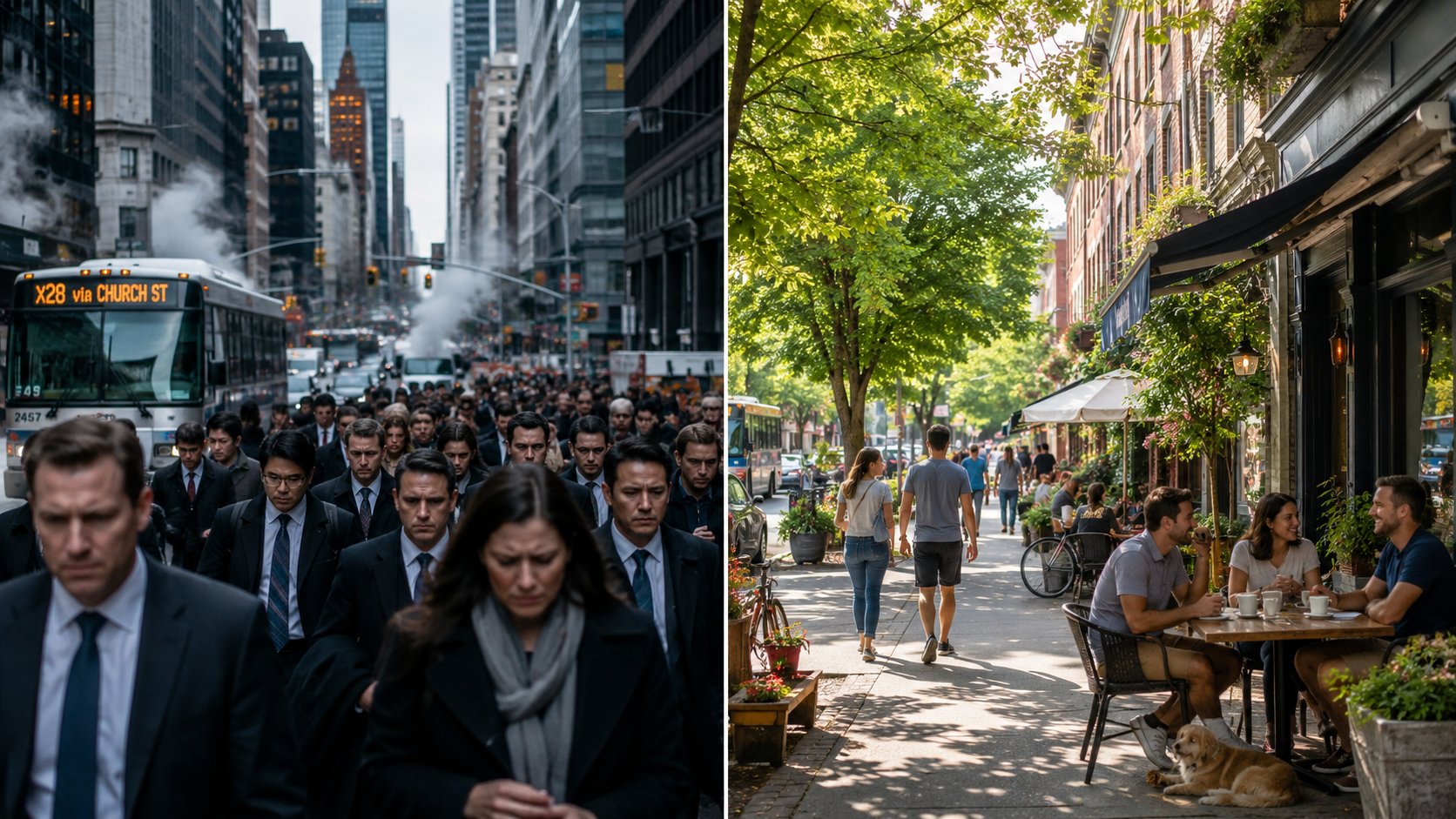
A city mismatch is often quiet. It may feel like tiredness, disconnection, or the slow loss of energy.
Signs a City Does Fit You
A fitting city will not be perfect. It will still have problems, bills, and frustration. But it usually gives you a few positive signals:
You want to explore. You can imagine a future there. Your routines become easier. You become more interested in your own health. You start having new ideas. You are not constantly fighting the environment. You can accept this city's trade-offs. You feel that something important in you is being awakened.
Real fit does not mean "no problems." It means the city's strengths nourish something important in you, and its weaknesses do not continually crush you. This is also what drives so many people to change completely after moving to a new city — the environment finally stopped working against them.
The right city will not solve everything, but it can make daily life feel lighter.
City Rankings Cannot Decide for You
City rankings can be useful. Best cities to live in. Most affordable cities abroad. Safest cities. Best cities for startups. These lists offer helpful data.
But rankings usually measure averages. You are not an average. You have your own income structure, personality, health needs, family situation, career stage, cultural preferences, and sense of beauty and belonging.
The same city can be paradise for one person and a slow drain for another. So use rankings as reference, not as destiny. The real answer has to return to you.
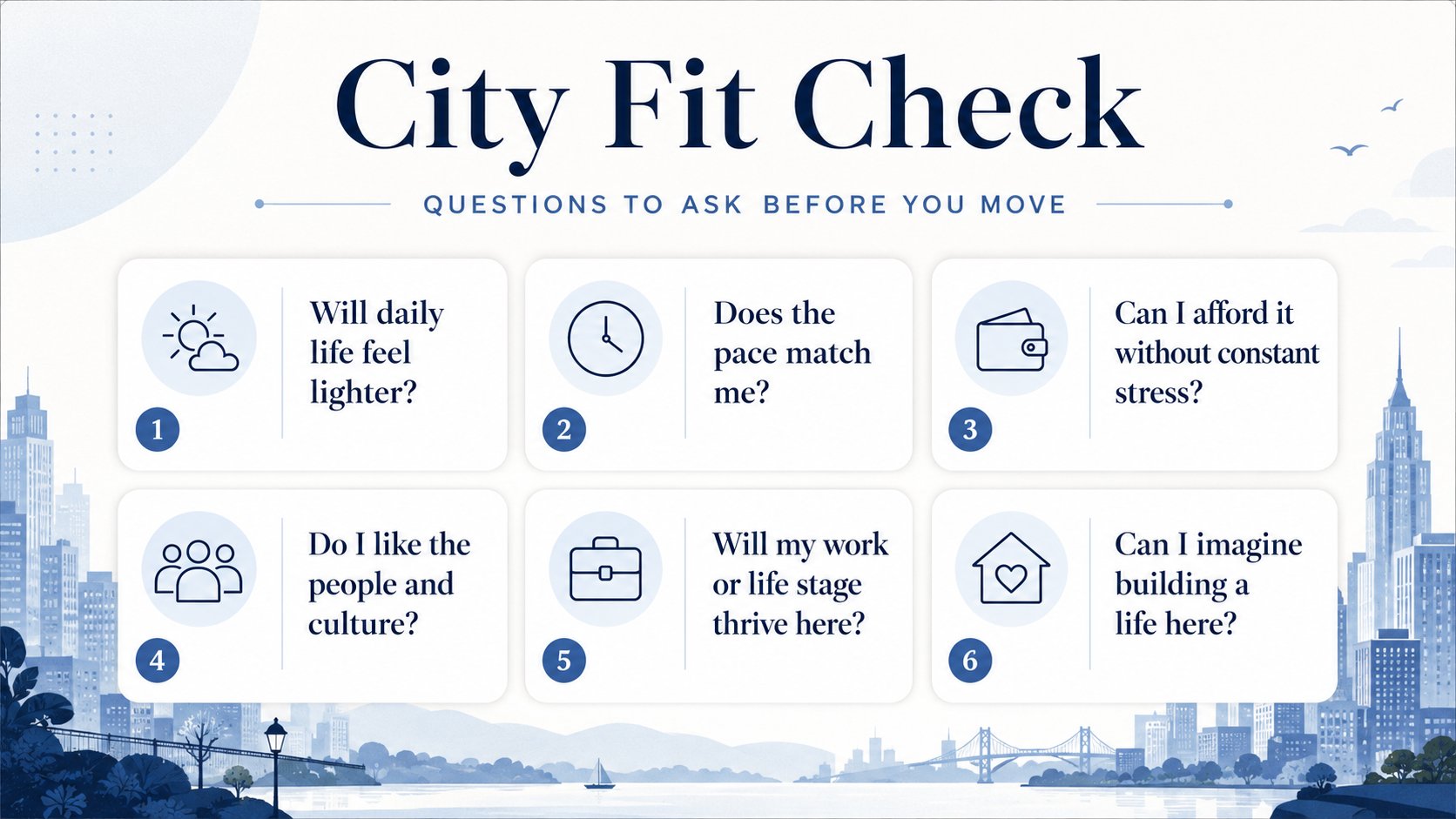
Do a City Fit Check Before You Move
Before deciding to move somewhere, ask yourself: Will daily life feel lighter here, or heavier? Will I want to go outside, or hide indoors? Does my income structure fit the cost of living? Does my current life stage need the opportunities this city offers? Can my emotional needs be met here? Am I escaping a problem, or moving toward a better environment?
There is no universal answer. But these questions can help you avoid a common mistake: assuming a city is right for you just because it looks good from the outside.

Before you move, ask whether the city supports your body, work, relationships, finances, and future.
Finding the Right City Is a Form of Life Judgment
A mature move is not impulsive. It is not moving to Lisbon, Dubai, Miami, or Tokyo just because someone else did. It is not turning a beautiful social media image into a life plan.
A mature move is a deeper form of life judgment. You begin to understand: I am not just looking for lower rent. I am not just looking for better weather. I am looking for an environment that can support the next stage of my life.
That is the meaning of City Soul. Your City Soul is not just a personality label. It is your inner sense of fit between who you are, how you live, and what kind of city can help you become more fully yourself.
You may not need a more famous city. You may need a more fitting one.
Find Your City Soul
Your next city is not just a destination. Take the free quiz and discover your city temperament, lifestyle preferences, and ideal urban energy.
Get Your Personalized Moving Cost Report
Full cost breakdown, visa guide, neighborhood analysis, and 90-day action plan — usually delivered to your email within a few minutes after payment.