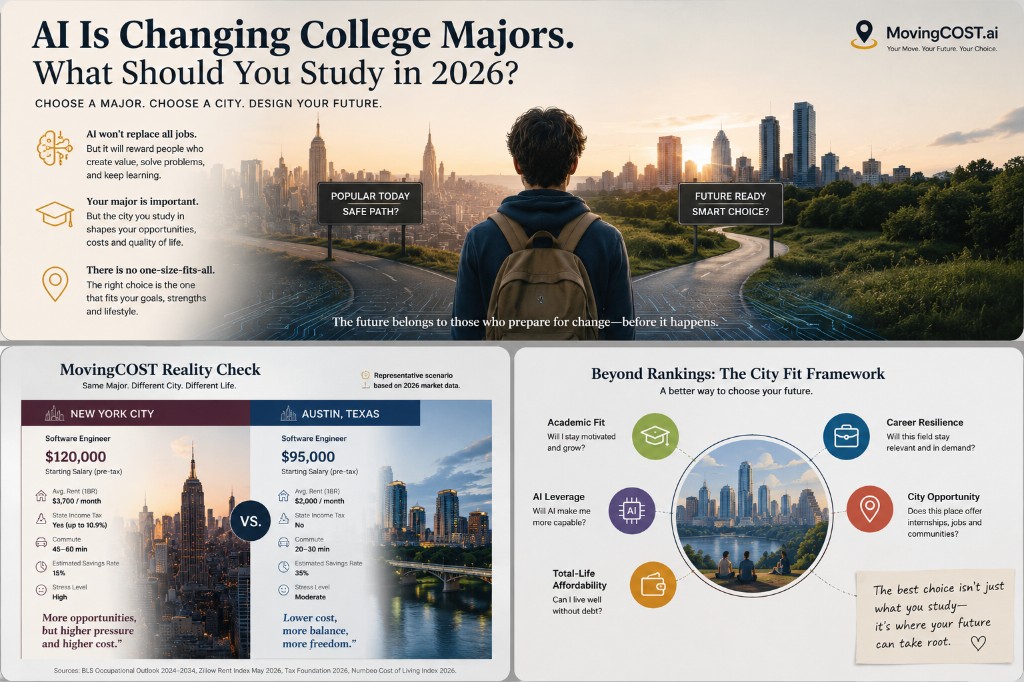
For decades, one question dominated conversations about college:
Which major will lead to a secure, well-paid career?
Families looked toward fields such as finance, accounting, law, engineering and computer science. Students compared university rankings, starting salaries and employment rates, hoping that one careful decision at age 18 would create a stable future.
In 2026, that decision feels far less certain.
Artificial intelligence is changing how companies write, analyze, design, communicate, diagnose, research and make decisions. Some entry-level tasks can now be completed in minutes. Others are being redesigned around collaboration between people and intelligent systems.
That does not mean college has lost its value.
It means students need a better way to evaluate value.
The most useful question is no longer simply:
“Which major pays the most?”
It may be:
“What combination of knowledge, human judgment, AI capability and location will give me room to grow?”
A degree still matters. But a degree alone is no longer a complete plan.
AI is not eliminating every profession. It is changing what employers value.
Public discussion about artificial intelligence often swings between two extremes.
One side says AI will replace most human work. The other says nothing fundamental will change.
Reality is more complicated.
Jobs are rarely made up of one task. They include research, communication, judgment, coordination, problem-solving, accountability and relationships. AI may automate part of a job without eliminating the occupation itself.
The greatest pressure is likely to fall on work that is:
- repetitive;
- highly standardized;
- easy to measure;
- based mainly on reorganizing existing information;
- performed with little responsibility for the final outcome.
Basic content production, routine translation, simple data preparation, standardized customer support and some junior analytical tasks are already being reshaped.
But AI also increases demand for people who can:
- define the right problem;
- verify whether an answer is reliable;
- combine knowledge from several fields;
- understand human behavior;
- make decisions under uncertainty;
- communicate with clients, patients, teams or communities;
- take responsibility when the stakes are high.
The future will not belong only to people who know how to use AI tools.
It will belong to people who know what should be done, why it matters and how AI can help them do it better.
Do not choose a major by title alone
A major is not a guaranteed career destination.
Two students can earn the same degree and build completely different lives. One may develop technical depth, complete internships, build a portfolio and learn to work with AI. Another may complete the required courses but graduate without evidence of practical ability.
Their diplomas may look similar. Their opportunities may not.
Before choosing a major, students should ask five questions.
1. What kind of problem do I want to solve?
A student interested in healthcare might become a nurse practitioner, biomedical engineer, health-data analyst, hospital administrator or medical-product designer.
The subject matters, but so does the kind of responsibility the student wants to carry.
2. Does the field depend on human judgment, trust or accountability?
Careers involving patient care, safety, regulation, leadership, complex negotiation or responsibility for real-world outcomes may be transformed by AI without becoming purely automated.
3. Will AI strengthen me—or compete directly with my most basic skills?
A future journalist who can investigate, verify sources and develop original reporting may use AI productively.
A future writer whose only skill is producing generic summaries faces a different risk.
4. Can this major connect with another discipline?
Some of the strongest future profiles may be combinations:
- computer science and healthcare;
- engineering and sustainability;
- psychology and product design;
- finance and data science;
- urban planning and climate resilience;
- communication and AI governance.
5. Where can this knowledge become a real opportunity?
A degree operates inside an economy.
The same graduate may encounter very different salaries, employers, housing costs, professional networks and quality of life in New York, Austin, Boston, Miami, Toronto, London or Singapore.
That is why choosing a major without considering the city can produce an incomplete decision.
Fields with strong potential—but no automatic guarantees
No responsible adviser can promise that one major will remain “safe” for decades. Technology, policy and economic demand will continue to change.
Still, several broad areas show strong long-term potential.
Data, AI and information systems
Demand continues to grow for people who can build intelligent systems, work with large datasets, secure digital infrastructure and translate technical capability into useful products.
But students should distinguish between learning to write routine code and learning to solve difficult technical or organizational problems.
A strong technology education should increasingly include:
- statistics;
- data quality;
- cybersecurity;
- AI evaluation;
- systems thinking;
- communication;
- ethics and governance;
- domain knowledge outside computing.
Healthcare and human services
Healthcare combines technical knowledge with regulation, trust, communication and direct responsibility for people.
AI may support diagnosis, scheduling, documentation and analysis, but healthcare systems still need professionals who can interpret information, coordinate care and make accountable decisions.
The field is also much broader than becoming a physician. It includes nursing, public health, mental-health services, medical technology, healthcare administration and health informatics.
Cybersecurity
As organizations become more dependent on cloud systems, AI platforms and connected infrastructure, security risks become more complex.
Cybersecurity is not simply a technical specialty. It increasingly requires knowledge of business operations, regulation, human behavior and crisis response.
Engineering and infrastructure
Electrical engineering, computer engineering, robotics, energy systems, civil infrastructure and advanced manufacturing connect digital intelligence to the physical world.
AI can help design and optimize systems, but roads, buildings, energy networks, machines and medical devices still have to function safely in reality.
Education and learning design
AI will change how people learn, but it will not eliminate the need for teachers, mentors and learning designers.
The opportunity may shift toward people who can combine subject expertise, human motivation, personalized learning and intelligent tools.
Urban planning, housing and climate resilience
Cities face increasingly difficult questions involving housing, transportation, energy, migration, affordability and climate risk.
Professionals who can combine policy, data, design and public communication may become more valuable as urban decisions grow more complex.
MovingCOST Reality Check: Same major, different life
Consider two representative graduates. They are not specific real individuals. Their situations are constructed from plausible early-career offers and publicly reported housing conditions in two major U.S. technology markets.
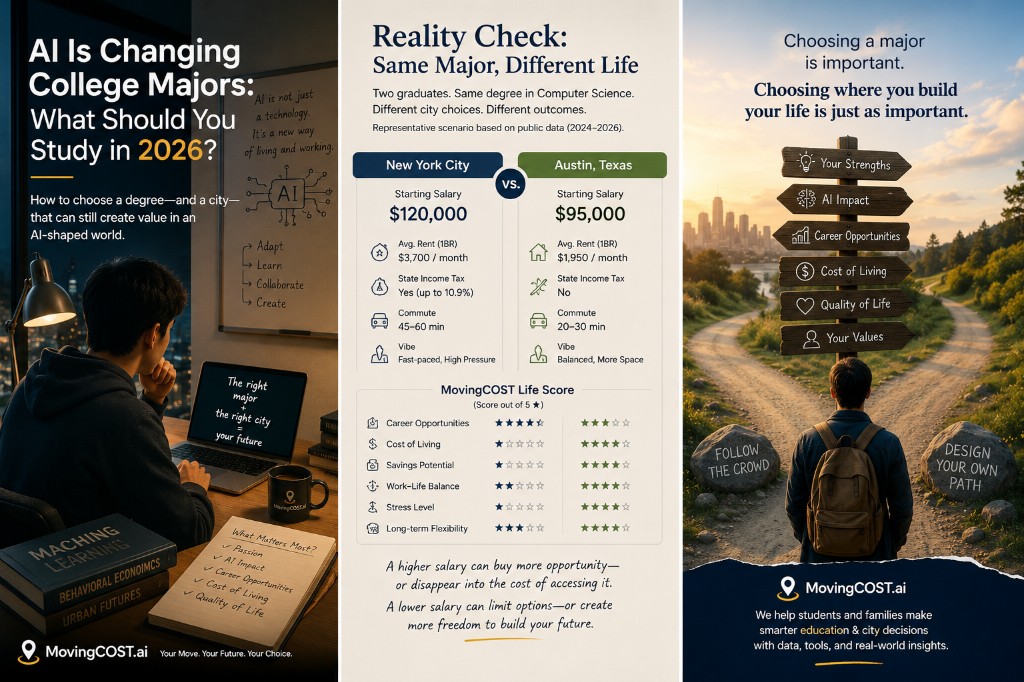
Illustrative representative scenario based on public salary and rental-market information. Individual outcomes vary.
Maya: Software graduate in New York City
Maya accepts a technology role in New York with a salary of $120,000 a year.
On paper, the offer looks clearly superior.
She has access to major employers, ambitious colleagues, cultural opportunities and a dense professional network. Her city may accelerate her career simply by placing her close to people and organizations shaping the industry.
But the financial picture becomes more complicated.
A typical New York rental can cost around $3,700 per month, before utilities, transportation, food and other living expenses. A graduate renting alone may therefore spend a very large share of take-home income on housing.
Maya may decide that the opportunity is worth the cost. She might share an apartment, accept less personal space or treat the first few years as an investment in professional growth.
That can be a rational decision.
But it is not the same as saying that the higher salary automatically produces the better life.
Daniel: Software graduate in Austin
Daniel accepts a technology role in Austin with a salary of $95,000 a year.
His salary is lower, and the local employer network may not offer the same concentration of global headquarters, investors and specialized opportunities as New York.
However, average Austin rent is closer to $2,000 per month, with many one-bedroom units listed below the citywide average.
Daniel may have more room in his monthly budget for savings, travel, professional courses or starting a small business. He may also prefer a different pace of life, climate and housing environment.
Again, that does not make Austin universally “better.”
If Daniel wants a particular career that is concentrated in New York, the lower cost of living may not compensate for fewer relevant opportunities. If Maya thrives on density, competition and cultural energy, New York may fit her far better.
The real lesson
Maya and Daniel studied the same subject.
The difference in their outcomes is not explained by salary alone.
It depends on:
- housing cost;
- career density;
- professional network;
- lifestyle preference;
- transportation;
- savings potential;
- tolerance for pressure;
- long-term personal goals.
This is the difference between a salary comparison and a life comparison.
A higher salary can buy more opportunity—or disappear into the cost of accessing that opportunity.
A lower salary can limit career options—or create more financial and personal freedom.
The right answer depends on the person.
This representative scenario is based on publicly available employment and rental-market information and plausible early-career outcomes. It does not describe specific individuals, and actual salaries, taxes, expenses and opportunities vary.
University ranking is only one part of the decision
Students and families often spend months comparing universities while giving relatively little attention to the surrounding city.
But the city affects:
- internships available during college;
- employers available after graduation;
- rent and transportation costs;
- access to professional communities;
- cultural and social adjustment;
- personal safety;
- mental health;
- the ability to remain after graduation;
- the real value of an expected salary.
A highly ranked university in an unaffordable or poorly matched city may create more stress than opportunity.
A less famous university in a city with strong industry connections, manageable costs and a supportive environment may produce an excellent outcome.
This does not mean rankings are meaningless.
It means rankings should be considered alongside City Fit.
At MovingCOST, City Fit means the relationship between a person and the place where that person will actually study, work and build a life.
A good City Fit is not necessarily the cheapest city or the city with the highest salaries.
It is the city where opportunity, affordability, personality and long-term goals work together.
International students face an even more complex equation
For international students, choosing a major is connected to additional questions:
- Can the family afford the full cost, not just tuition?
- Are internships accessible?
- What work authorization rules apply?
- Is the degree recognized across countries?
- Are employers in the city familiar with hiring international graduates?
- Can the student build a useful network before graduation?
- What happens if immigration or employment plans change?
A program may appear affordable until housing, insurance, transportation and travel are included.
Another program may look expensive but offer stronger industry access, scholarships or paid work opportunities.
The correct comparison is therefore not:
tuition versus tuition.
It is:
total cost versus total opportunity.
The best major may be a flexible foundation
Students sometimes feel pressured to predict the exact job they will hold ten years from now.
That is rarely realistic.
A better goal is to choose a foundation that provides:
- transferable knowledge that remains useful across roles;
- practical evidence of ability, such as internships and projects;
- AI fluency, including the ability to evaluate and improve machine output;
- human skills that technology cannot easily reproduce;
- room to specialize as the market changes.
This may mean combining a traditional major with a minor, certificate, portfolio or sequence of practical projects.
A biology student might add data analysis.
A business student might learn automation and product design.
A computer science student might develop expertise in healthcare, finance, education or urban systems.
A communication student might focus on research, community trust and strategic storytelling rather than generic content production.
The name of the degree matters.
The architecture of the student’s capabilities matters more.
A smarter decision framework for 2026
Before committing to a university and major, compare the following five dimensions.
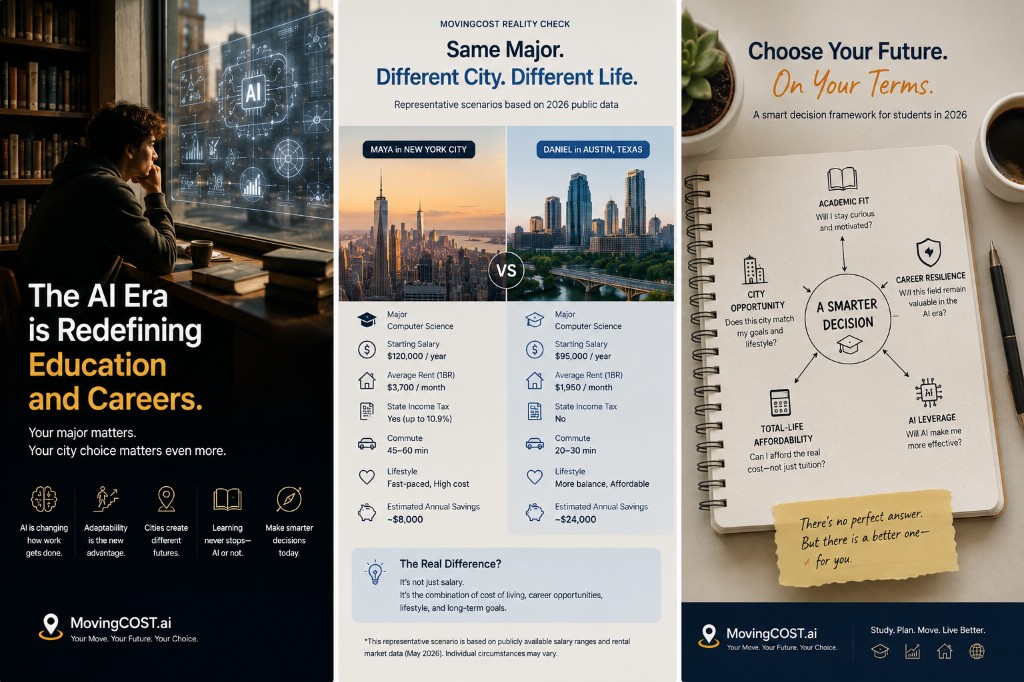
Academic fit
Will the student remain curious enough to do difficult work for several years?
Career resilience
Does the field contain work requiring judgment, accountability, technical depth or human relationships?
AI leverage
Can the student use AI to become more capable rather than merely compete against automated output?
City opportunity
Does the location provide internships, employers, communities and industries connected to the degree?
Total-life affordability
After tuition, housing, transportation, insurance and everyday living costs, is the plan financially sustainable?
A strong decision performs reasonably well across all five.
A prestigious degree that fails the affordability test may create damaging debt.
An inexpensive program with weak career access may provide poor value.
A high-paying field that does not match the student’s strengths may lead to burnout.
The goal is not to find a perfect answer.
It is to avoid making a major life decision using only one attractive number.
What MovingCOST is building next
MovingCOST began with a simple idea: help people understand the real cost of moving.
But moving is rarely only about transportation.
People move for education, work, family, safety, affordability and a better future. The largest cost is often not the moving truck or plane ticket.
It is the consequence of choosing the wrong path, the wrong city or an unsustainable financial plan.
That is why we are developing the Study, Major & Cost Planner—a decision tool designed to help students and families examine:
- academic interests;
- the changing value of majors;
- tuition and scholarships;
- housing and living costs;
- internship and career opportunities;
- the relationship between a student and a city.
The goal is not to tell every student what to study.
It is to help each student ask better questions before making one of life’s most expensive decisions.
Final thought
AI will not make every degree worthless.
It will make passive decision-making more dangerous.
Students can no longer assume that a popular major, a famous university or a high starting salary will automatically produce a good future.
The strongest path will often combine:
knowledge, adaptability, human judgment, AI capability and the right city.
Your major shapes what you learn.
Your city shapes where that knowledge can become a life.
Choose both carefully.
Plan More Than a Degree. Plan the Life Around It.
MovingCOST is developing a Study, Major & Cost Planner to help students and families compare academic direction, city opportunity, tuition, housing and total living costs.
Study, Major & Cost Planner — Coming Soon